MENU
PH | PHP

PH | PHP
-
- All Pipettes, Dispensers & Automated Liquid Handlers
- Mechanical Pipettes
- Electronic Pipettes
- Multi-Channel Pipettes
- Positive Displacement Pipettes & Dispensers
- Pipette Tips
- Bottle-Top Dispensers
- Pipette Controllers
- Dispenser & Pipette Accessories
- Automated Pipetting
- Automation Consumables
- Automation Accessories
- Liquid Handler & Pipette Services
Sorry, we couldn't find anything on our website containing your search term.
You are about to leave this site.
Please be aware that your current cart is not saved yet and cannot be restored on the new site nor when you come back. If you want to save your cart please login in into your account.
Sorry, we couldn't find anything on our website containing your search term.
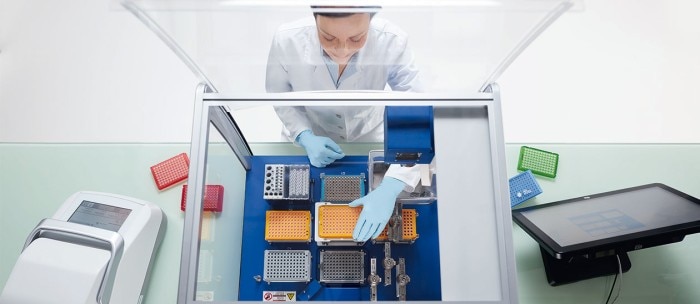
Purification of nucleic acids – How to tackle routines and gain time?
Dr. Stefanie Rösel Beyond Science
- Next Generation Sequencing
- Automation
- Essay
- Health & Medicine
Aged more than one century, nucleic acid purification is anything but ordinary. Imagine routine DNA/RNA purification becomes simple and easy to perform without losing reproducibility, precision and quality? Read how to tackle it…
Nucleic Acid Purification (NAP), also termed Nucleic Acid Extraction (NAE), is a central part upstream of many analysis workflows ranging from PCR to NGS. The need for high-throughput assays and nucleic acid analyses in areas like microbiome and cancer research up to pharmacogenomics is constantly increasing, including the need for purified genomic nucleic acids, RNA, mitochondrial DNA, or plasmids.
Respective disruption methods are as variableous as the input material is. With one sample, a technique might works well, and with another sample it might not work at all. That certainly sounds familiar, doesn't it? Independent of the input material, there are two major approaches for DNA/RNA purification that have evolved over time, and are used by most commercially available protocols: silica matrices and magnetic beads. The silica-based procedure with the typical spin columns is easy to perform fast, and delivers highly pure DNA/RNA. The other technique using magnetic beads is very elegant and efficient: Nucleic acids can be separated from complex mixtures without any centrifugation steps.
Respective disruption methods are as variableous as the input material is. With one sample, a technique might works well, and with another sample it might not work at all. That certainly sounds familiar, doesn't it? Independent of the input material, there are two major approaches for DNA/RNA purification that have evolved over time, and are used by most commercially available protocols: silica matrices and magnetic beads. The silica-based procedure with the typical spin columns is easy to perform fast, and delivers highly pure DNA/RNA. The other technique using magnetic beads is very elegant and efficient: Nucleic acids can be separated from complex mixtures without any centrifugation steps.
Read more
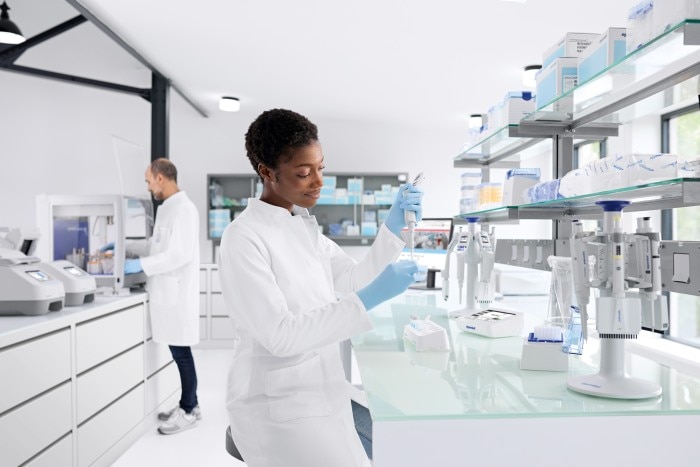
Nothing to give away
Despite the purification of nucleic acids being a routine procedure in molecular biology labs, it is time consuming and can get challenging. Every one of us has probably experienced that manual pipettes can become a hurdle for precision and reproducibility. For example, a challenge we’ve previously discussed in our lab academy is pipette tips dripping when handling volatile liquids like ethanol. Also, manually processing magnetic beads increases the risk of carryover beads that interfere with downstream applications. .
Plus, processing various input materials such as tissue or plants challenge your lysis by demanding a maximum on flexibility. The nature of the target molecule can add another layer of complexity. For instance, purifying DNA is a relatively straightforward process, thanks to its stability. However, purifying RNA is a completely different story – its inherent instability makes the process far more demanding. And with time pressure on the back of your neck, purifying challenging samples can get tricky with 96-well plates. The worst thing is to go through the whole purification process, and at the end have no yield. But pessimism aside, here comes the good news.
Your partner to increase throughput and reproducibility
Delegate your routine nucleic acid purification and enjoy peace of mind! An automated liquid handling robot allows you to:
- Automate and standardize routine pipetting work
- Perform high-throughput applications in up to 96-well plates with high sample processivity
- Process batches with a multitude of samples (e.g. blood, tissues)
- Release time resources
- Reduce manual pipetting errors
- Maximize assay reproducibility
- Automate documentation
Nucleic acid purification with silica spin columns and magnetic beads are perfectly suited for automation. Particularly magnetic beads are very convenient. The procedure is easy to execute and is scalable. If using filter plates, the process can be fully automated, by replacing the centrifuge with a vacuum-based purification approach. Don’t worry about changing from single tubes to plates. It's definitely worth it!
Read more
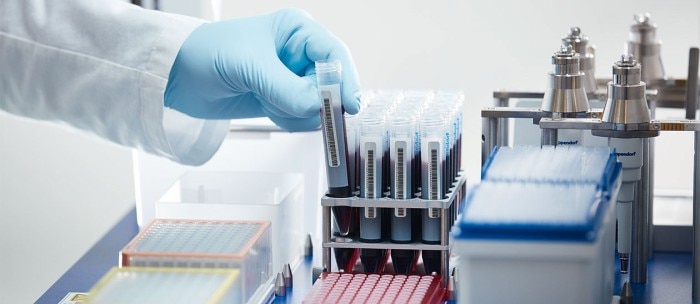
The robot has many skills that will make your life easier:
Lab automation, standardization, and documentation are the keys for reliable and reproducible purification of nucleic acids. Work smart and let the robot work hard!
- Precise pipetting of samples and reagents
- Simultaneous handling of large numbers of samples with precision and speed
- Automatic tracking of samples and results plus optional barcode scanning features
- Fully automated and validated protocols for silica-matrices or magnetic beads kits
Lab automation, standardization, and documentation are the keys for reliable and reproducible purification of nucleic acids. Work smart and let the robot work hard!
Read more
Videos not loading, because cookies have been rejected. Change your
You can learn more about how to improve your nucleic acid purification workflows in our on-demand webinar. And for even more information on how automated liquid handlers can enhance the purification of nucleic acids and other molecular biology workflows, visit our automated pipetting webpage, and explore the resources below.
Read more
Resources

Brochure
Application note
Application note
Application note
Application note
Application note
Application Note
PDF
Short Protocol 43
PDF
Short Protocol 44
PDF
Short Protocol 45
PDF